Take Shelter is one of those films that relies on a performance of one actor, a performance that is central to the greatness of the film as a whole. Michael Shannon, who is always totally captivating (particularly in Bug, Shotgun Stories, Revolutionary Road, and--lately--HBO's Boardwalk Empire as Prohibition agent Nelson Van Alden), stars as Curtis LaForche, a construction worker whose dreams and visions of an impending doomsday storm--full of oil-slicked rain and violent chain lightning--draws him into the depths of underground storm shelters and madness. It's a performance that is nothing short of incredible, and it adds another bullet point on my list of reasons of why the 2012 Oscar nominations were the equivalent of a sack filled with foul dog feces (not that the five Best Actor nominees were not good, but I'd take Shannon's performance over any of them).
Michael Shannon is an actor that always looks creepy and uneasy, like he is about to snap and murder everyone on screen at any moment. But his portrayal of Curtis in Take Shelter is better and more subtle than that: at the beginning of the film, he seems content, even happy, a man with nothing to gain but everything to lose. He's got a supporting wife, a cute daughter who is deaf (she's on the verge of a transplant that will help her regain some of her hearing if the family's health insurance comes through), and a loving family dog. His house sits in a field where the skies are endless and clouds look like mountains on the horizon line.
Everything's great--until the dreams start. At first they are short and intense, a snippet of the family dog attacking him and biting his arm (his arm hurts the entire next day) or chain lightning with dark, ominous clouds littering the big sky. The dreams are ultra-realistic, and they confuse Curtis and the viewers of Take Shelter about what is real and what is imagination. Director Jeff Nichols, whose previously mentioned Shotgun Stories is also a small, intense drama starring Shannon, is already a pro at building suspense and dread. As the dreams occur more frequently and more intense, Curtis must come to grips with one of two things: either his visions are the product of the illness in his mind, or they are something far more serious, real visions signifying the devastation of everything he has in his life due to a more dangerous and unpredictable climate.
Curtis and his erratic behavior start to worry everyone in his life, specifically his wife (Jessica Chastain, in her 7th film role this year), who is amazingly forgiving and supportive of her husband who is losing his shit. His co-worker, Dewart (portrayed by another Boardwalk alum, Shea Whigham), also bear's the brunt of the fallout of the vivid dreams. The news of his possible mental illness spreads quickly, as news in small towns seemingly always does without effort, and soon the paranoia that Curtis feels seems justified in some regard. Far into the film, Shannon's portrayal of Curtis at a community dinner--where everyone is staring and whispering like cruel schoolchildren--is especially poignant. The outburst is shocking, sad, and brilliant acting.
I watched Take Shelter after I wrote my Top 10 list for 2011. It wouldn't have made that list, but it's not too far away. It's a slow-building, intense drama about a man who may or may not be mentally ill. The story as a whole, without giving away its ending that leaves you thinking days after watching it, can be--without much effort--taken as an allegory about global warming. Curtis's visions, like the more-and-more powerful storms and tornado patterns that are happening every year, can be accepted or denied. But acceptance or denial doesn't affect the weather, even when the glaciers are melting at an astounding rate, the streets are flooding with rain, and the oceans are turning into hot tubs.
Saturday, March 3, 2012
Sunday, February 26, 2012
Act of Valor: A Parable of Propaganda or Fist-Pumping Patriotism? Neither.
You may have seen the movie trailer for Act of Valor during the Super Bowl a few weeks ago. At first, it seemed like a commercial for the Navy, one of those ads that ends with the words, "Be One, Be Strong, Be Navy" (or whatever those recruitment commercials state at the end). But then the preview continues, showing some impressive military action for just a small commercial. Then the realization truly sets in: this is a film starring active duty Navy Seals, a fictional account using the military's newest and brightest tactics and technology. It was difficult to not be a little curious, or even excited if you were or are a member of the armed forces. Due to it's peculiar nature (initial filming was even supposed to be a recruitment video for the Navy), Act of Valor is a unique film to review.
Let's get a few things out of the way first: these are my impressions and opinions on Act of Valor as a motion picture. I don't care if you're pro-war or anti-war, if you think a movie starring active duty Navy Seals is a glorification of violence against people of other nationalities, or if you think this film is meant to brainwash your children to strap on an M4, sign up for the military, and go blow the head off of some Jihadist (I surely am no closer to signing my name up--action movies are called "escapist entertainment" for a reason). I care about how this movie works as a movie. On that account, it basically succeeds: Act of Valor is an entertaining movie with sub-par acting but awesome action set pieces. Sort of the way it would be if you made a movie starring non-actors who killed people on dangerous missions for a living.
As I said before, the film started out as an idea to recruit people on the fence about joining the Navy. From there, the filmmakers realized that the action was exciting and thrilling enough to turn into a motion picture. Act of Valor is essentially based around two Seal missions: one is about rescuing a kidnapped CIA operative who has been taken to a fortified encampment in the jungle. During this mission, the Seals recover a phone that provides information on a terrorist plot against America. The second mission is stopping this threat in the cartel-controlled towns and maze-like underground tunnels on the Mexi-Cali border.
These two missions and the execution of them provides the film with all of its thrill and excitement. If my grade of this film was solely based on these great action scenes, I would give it an A-. The jungle extraction starts with amazing stealth and sniper head shots. The violence is quick and brutal, which each shot landed sounding like a squished watermelon. As the team moves closer and closer and then finally into the village, the combat switches to quick close quarter shooting within the shanty buildings. The truck chase and boat combat that follows is just icing on the bloody cake. This sequence of events was my favorite in the film. But the mission on the Mexico border was great too: full of bombs, grenades, and heroic acts of bravery, this dark and gritty portion of the film was violent and filled with a sense of sadness. The only detriment to the action scenes in Act of Valor was the director's overuse of the first person camera angle. I know you want video game players to purchase tickets for your movie, but over reliance on this technique caused a few minutes of the battle to feel like Call of Duty 17: Navy Seals. If I wanted to wish I had a controller in my hand, I would have stayed at home and grabbed a controller.
Everything other than the missions and execution of them is the worst part of the film. If my grade of this film was solely based on the acting, character development, and interaction between the Seals and their families before and after the missions, I would give it a D. The Seals in the film were portrayed by real Navy Seals. I surely didn't need any convincing of that after the first three minutes of the film's run time. There is no need to speak of any specific performances, as they are all interchangeable. Two cringe-worthy scenes come to mind: one in early in the film as two Seals sit at a bar table drinking beer, and one announces that him and his wife are having a baby. The conversation is hollow and robotic. The other scene is one of the same Seals saying goodbye to his wife as he leaves for deployment. It's as if you grabbed two random strangers and had them read the script in monotone. Unfortunately the acting isn't so bad it's funny, like in The Room--it's just bad.
One may argue that these dudes are cold, calculated killing machines, so you can't expect them to show emotion. And that's fine: but you can still show no emotion and be good at acting. Does anyone remember Javier Bardem in No Country for Old Men? When in combat, these fellas don't need to act, because combat's what they are incredibly good at. It's natural. But take them out of that, and it doesn't make for a great motion picture. Luckily, the intelligent, brutal, gadget-filled action scenes hold the movie well above the shit pile. Act of Valor doesn't bother with the important questions about what happens to these men after they get maimed or injured, after they get sent home to little fanfare, after their friends brutally die in front of their eyes. It leaves those questions for the next documentary. Act of Valor focuses on which direction the next threat is coming from and how fast the Seal team can foil the plot. (B-)
Let's get a few things out of the way first: these are my impressions and opinions on Act of Valor as a motion picture. I don't care if you're pro-war or anti-war, if you think a movie starring active duty Navy Seals is a glorification of violence against people of other nationalities, or if you think this film is meant to brainwash your children to strap on an M4, sign up for the military, and go blow the head off of some Jihadist (I surely am no closer to signing my name up--action movies are called "escapist entertainment" for a reason). I care about how this movie works as a movie. On that account, it basically succeeds: Act of Valor is an entertaining movie with sub-par acting but awesome action set pieces. Sort of the way it would be if you made a movie starring non-actors who killed people on dangerous missions for a living.
As I said before, the film started out as an idea to recruit people on the fence about joining the Navy. From there, the filmmakers realized that the action was exciting and thrilling enough to turn into a motion picture. Act of Valor is essentially based around two Seal missions: one is about rescuing a kidnapped CIA operative who has been taken to a fortified encampment in the jungle. During this mission, the Seals recover a phone that provides information on a terrorist plot against America. The second mission is stopping this threat in the cartel-controlled towns and maze-like underground tunnels on the Mexi-Cali border.
These two missions and the execution of them provides the film with all of its thrill and excitement. If my grade of this film was solely based on these great action scenes, I would give it an A-. The jungle extraction starts with amazing stealth and sniper head shots. The violence is quick and brutal, which each shot landed sounding like a squished watermelon. As the team moves closer and closer and then finally into the village, the combat switches to quick close quarter shooting within the shanty buildings. The truck chase and boat combat that follows is just icing on the bloody cake. This sequence of events was my favorite in the film. But the mission on the Mexico border was great too: full of bombs, grenades, and heroic acts of bravery, this dark and gritty portion of the film was violent and filled with a sense of sadness. The only detriment to the action scenes in Act of Valor was the director's overuse of the first person camera angle. I know you want video game players to purchase tickets for your movie, but over reliance on this technique caused a few minutes of the battle to feel like Call of Duty 17: Navy Seals. If I wanted to wish I had a controller in my hand, I would have stayed at home and grabbed a controller.
Everything other than the missions and execution of them is the worst part of the film. If my grade of this film was solely based on the acting, character development, and interaction between the Seals and their families before and after the missions, I would give it a D. The Seals in the film were portrayed by real Navy Seals. I surely didn't need any convincing of that after the first three minutes of the film's run time. There is no need to speak of any specific performances, as they are all interchangeable. Two cringe-worthy scenes come to mind: one in early in the film as two Seals sit at a bar table drinking beer, and one announces that him and his wife are having a baby. The conversation is hollow and robotic. The other scene is one of the same Seals saying goodbye to his wife as he leaves for deployment. It's as if you grabbed two random strangers and had them read the script in monotone. Unfortunately the acting isn't so bad it's funny, like in The Room--it's just bad.
One may argue that these dudes are cold, calculated killing machines, so you can't expect them to show emotion. And that's fine: but you can still show no emotion and be good at acting. Does anyone remember Javier Bardem in No Country for Old Men? When in combat, these fellas don't need to act, because combat's what they are incredibly good at. It's natural. But take them out of that, and it doesn't make for a great motion picture. Luckily, the intelligent, brutal, gadget-filled action scenes hold the movie well above the shit pile. Act of Valor doesn't bother with the important questions about what happens to these men after they get maimed or injured, after they get sent home to little fanfare, after their friends brutally die in front of their eyes. It leaves those questions for the next documentary. Act of Valor focuses on which direction the next threat is coming from and how fast the Seal team can foil the plot. (B-)
Wednesday, February 22, 2012
Netflix This: Blood Simple
Blood Simple was released the year that I popped out of the womb (10 pounds-12 ounces), 1984. It took me over twenty years to look into the back catalog of the Coens' films (the past has a way with catching up with you), and out of their fifteen major releases, Blood Simple is my third favorite. If there was one word that could describe the 1984 film, I would use Tight. I don't mean Tiiiiiiiiiiiiight like the kids on the streets with their pants hanging below their ass crack and rap music blaring would say (though it surely is that too). I also don't mean Tight like how a Catholic Priest would describe a choice piece of 10-year-old boy. I mean Tight: simple, short, effective and every scene seems placed and played out to perfection.
The plot and performances are great: Julian owns a bar, and he has thoughts of hiring a private eye to murder his wife and lover. The wife, Abby (Frances McDormand, who is so great in Fargo), is having an affair with the bartender of the joint, Ray. The private eye, Loren, is portrayed by M. Emmet Walsh, a familiar face who has appeared in over 100 film and television projects. What follows is a film full of twists and turns of betrayal and murder that are still exciting almost 30 years after the theatrical release date. The characters act like real human beings as they make decisions and mistakes that come back to haunt most of them by the time the end credits roll.Blood Simple taps into some basic fears that we all would feel if we became involved in a similar situation. A character is shot and blood pools on the hardwood floor. What would you use to clean it up? I hope--for the character's sake--that blood splatter analysis isn't as perfected as it is in Showtime's Dexter. How do you dispose of a dead body? A better question: how do you live with yourself after disposing of a dead body? The motive for all of the action is almost always selfish in its nature--surviving, no matter what the cost. The film is dark but comic too. And a few of the plot twists are a bit over-the-top, but everything seems necessary to add excitement to the proceedings.
The direction, though, is where Blood Simple really shines. Some of the camera angles and shooting techniques are still super cool and original to this day. It's an early example of the masterful work that the Coens have applied in their more thrilling films. The Coens are two brothers that love making films, and that statement is obvious from the first scene in Blood Simple to the last. It introduced the audience to their clever and darkly humorous storytelling abilities and solidified the fact that they were two filmmakers to watch for decades to come, a fact that has come to fruition since the year I was born.
Saturday, February 18, 2012
Netflix This: Cube
I recently revisited Splice, the freaky 2009 film starring Adrien Brody and Sarah Polley about a couple who delve too deep into human/animal gene splicing. The film was a story about how science is almost about to catch up with fiction, creating a world in which a creature with human genes and animal genes seems entirely possible. The film's directed by a man named Vincenzo Natali, and I came to the realization that I had seen another one of his films a few years ago (his first film, actually). That film is called Cube.
Cube is a simple and effective little sci-fi thriller that is extremely memorable in it's sparseness. A man wakes up. But he's not on a warm comforter-covered pillowtop mattress--he's on the hard and drab floor of a 14 by 14 foot cube. He has no clue where he is or how he could have possibly woken up there. Eventually he discovers that he is in the middle of a gigantic maze of interlocking cubes with six other people with no food or water to speak of. In case you didn't know, you need food and water to survive for longer than a short period of time, so the group must work together, moving from cube to cube to find a way out.
Sounds pretty simple and boring, no? Thankfully (for the viewers of the movie Cube, not the characters locked inside), as the people move from box to box, they come across clever and brutal booby traps that pose problems for the seven individuals. Maybe one cube has a swinging, sharp blade that they all have to navigate if they don't want to lose a limb. Maybe another cube has a pressure sensitive floor that turns the cube into a fire-filled boiler. Whatever the problem may be, the cast does a great job with not much to work with: there's Quentin, a police officer who becomes the leader for the group. Holloway is a doctor who becomes overwhelmed with the stress of the situation. Rennes is a criminal escape artist who can't figure out how to escape. There's also Leaven and Kazan, a math teacher and autistic man, respectively, and their talents with numbers bring the group closer to the truth of their plight.
The characters bring many theories to the table about their situation: could it be a government experiment to see how people react in a secluded environment? Could the group have been abducted by aliens and placed in a futuristic puzzle? Or is this just some rich man's "entertainment"? Ultimately, the answer doesn't particularly matter. Cube is a film about human beings and the helpfulness or betrayal that occurs when a group of people come together for a common goal: getting the fuck out of the cube, no matter what.
Cube is a simple and effective little sci-fi thriller that is extremely memorable in it's sparseness. A man wakes up. But he's not on a warm comforter-covered pillowtop mattress--he's on the hard and drab floor of a 14 by 14 foot cube. He has no clue where he is or how he could have possibly woken up there. Eventually he discovers that he is in the middle of a gigantic maze of interlocking cubes with six other people with no food or water to speak of. In case you didn't know, you need food and water to survive for longer than a short period of time, so the group must work together, moving from cube to cube to find a way out.
Sounds pretty simple and boring, no? Thankfully (for the viewers of the movie Cube, not the characters locked inside), as the people move from box to box, they come across clever and brutal booby traps that pose problems for the seven individuals. Maybe one cube has a swinging, sharp blade that they all have to navigate if they don't want to lose a limb. Maybe another cube has a pressure sensitive floor that turns the cube into a fire-filled boiler. Whatever the problem may be, the cast does a great job with not much to work with: there's Quentin, a police officer who becomes the leader for the group. Holloway is a doctor who becomes overwhelmed with the stress of the situation. Rennes is a criminal escape artist who can't figure out how to escape. There's also Leaven and Kazan, a math teacher and autistic man, respectively, and their talents with numbers bring the group closer to the truth of their plight.
The characters bring many theories to the table about their situation: could it be a government experiment to see how people react in a secluded environment? Could the group have been abducted by aliens and placed in a futuristic puzzle? Or is this just some rich man's "entertainment"? Ultimately, the answer doesn't particularly matter. Cube is a film about human beings and the helpfulness or betrayal that occurs when a group of people come together for a common goal: getting the fuck out of the cube, no matter what.
Wednesday, February 8, 2012
Lilyhammer, Netflix's first foray into original programming, already an interesting watch for fans of The Sopranos (and Norway)
Early on in the first episode of Lilyhammer, Steven Van Zandt, playing a New York mobster named Frank "The Fixer" Tagliano (not unlike his role as Silvio Dante in HBO's The Sopranos), does something that Silvio would never do, even if it meant spending life in a maximum security prison: give all of his information to the FBI to become--what is known in the mob world--a rat. The authorities ask him where he might like to spend the rest of his life in the Witness Protection Program. Florida or somewhere else in the States? Too easy to be found and get whacked. The Bahamas? Frank's not too keen on the "melanoma". No, Frank chooses to be sent to Lillehammer, Norway (the show's title is a play on how Frank pronounces the place), the site of the 1994 Winter Olympics. It seems nice there, he assumes.
So begins this fish-out-of-water story that could--after the first episode, at least--be titled, The Sopranos 2: Silvio in Snow. And that's not a bad thing: much of the same dark humor, drama, violence and vulgarity is present here, even if the show isn't quite as expertly crafted as HBO's classic. Lilyhammer also looks absolutely great--shot mostly in Norway, it looks as cold and unforgiving as it probably is in real life for someone not used to the conditions. Frank sticking out like a sore thumb is most of the fun: he can understand some of the language, but dumb people will want to avoid Netflix's first show due to the many subtitles. The first episode is about the many funny interactions that occur upon his initial arrival and a myriad of misunderstandings that Frank chalks up to "cultural differences".
You've gotta hand it to Netflix, though: jumping into the original series realm that is dominated by HBO, AMC and Showtime is a ballsy move but also a necessary one. There's a reason HBO doesn't let Netflix stream any if its wonderful classics or new hits. It feels almost like an experiment: Lilyhammer was released this past Monday, and all eight of its Season One 45(ish) minute episodes (commercial-free) are available for instant streaming subscribers at any time. It's a new and hopefully fruitful undertaking for the company, as my Instant Queue was getting pretty stale in the new-and-exciting-show department. Later this year Netflix brings us House of Lies, directed by David Fincher and starring Kevin Spacey, and in 2013 we get another new season of Arrested Development before the movie. Here's hoping Netflix continues in this new direction instead of hiking up the price to my Blu-Ray rentals every month. But for now, time to click play on Episode 2 of Lilyhammer.
So begins this fish-out-of-water story that could--after the first episode, at least--be titled, The Sopranos 2: Silvio in Snow. And that's not a bad thing: much of the same dark humor, drama, violence and vulgarity is present here, even if the show isn't quite as expertly crafted as HBO's classic. Lilyhammer also looks absolutely great--shot mostly in Norway, it looks as cold and unforgiving as it probably is in real life for someone not used to the conditions. Frank sticking out like a sore thumb is most of the fun: he can understand some of the language, but dumb people will want to avoid Netflix's first show due to the many subtitles. The first episode is about the many funny interactions that occur upon his initial arrival and a myriad of misunderstandings that Frank chalks up to "cultural differences".
You've gotta hand it to Netflix, though: jumping into the original series realm that is dominated by HBO, AMC and Showtime is a ballsy move but also a necessary one. There's a reason HBO doesn't let Netflix stream any if its wonderful classics or new hits. It feels almost like an experiment: Lilyhammer was released this past Monday, and all eight of its Season One 45(ish) minute episodes (commercial-free) are available for instant streaming subscribers at any time. It's a new and hopefully fruitful undertaking for the company, as my Instant Queue was getting pretty stale in the new-and-exciting-show department. Later this year Netflix brings us House of Lies, directed by David Fincher and starring Kevin Spacey, and in 2013 we get another new season of Arrested Development before the movie. Here's hoping Netflix continues in this new direction instead of hiking up the price to my Blu-Ray rentals every month. But for now, time to click play on Episode 2 of Lilyhammer.
Wednesday, February 1, 2012
The Top 10 Films of 2011
I consider the year 2011 to have been an off year for new, original and incredibly great cinema. Nine out of the ten top-grossing films in the world this year were sequels, and the odd film out was The Smurfs (six of the ten were sequels of sequels, and five of the ten were sequels to already-shitty films). Despite the negativity, I saw 62 (and counting) films released from January to December. The year 2012 is looking like it's going to totally blow 2011 out of the water in terms of quality, especially due to The Dark Knight Rises, Prometheus, Gravity, and Django Unchained. Enough bitching and complaining, you say? Okay, okay. There were some bright spots in 2011, as there are with any year. These were the greats, the one's that will last in my memories for years to come, the ones that I thought about far after the credits rolled and the theater's lights flickered back to life:
10. The Guard
The poster for The Guard states that it is like "Hot Fuzz plus In Bruges...Better than both." Unfortunately, that statement rings false, as it is better than neither. No worries, though: The Guard--directed by John Michael McDonagh (brother of In Bruges director Martin McDonagh)--is the funniest comedy of the year. Filled with Irish slang and vulgar expletives, The Guard tells the story of Boyle (Brendan Gleeson in the best role of his career [and he's been in some wonderful stuff]), an unorthodox cop who has to team up with an uptight FBI agent to take down an international drug smuggling group. It's hilarious, violent, and contains some of the best dialogue heard this year (a lot like In Bruges back in 2008). Every quip and sarcastic remark is stated to perfection, and when the credits roll, you'll be cheering when Gleeson's name crosses the screen.
9. Tinker Tailor Soldier Spy
Like most things in the movies, the real-life counterpart is probably a whole lot less exciting. Tinker Tailor Soldier Spy is the real life version of international espionage, and--although there are no invisible cars, rock-hard chicks in bikinis, or intricate fights with hand-to-hand combat--it shows us that excitement can be found anywhere where betrayal is present. The title of the film contains the code names of four of the main characters. Which one, if any of them, is a spy double-crossing their own government and giving important information to the Soviets? It doesn't particularly matter, not when you're watching an all-star cast of British actors smoke cigarettes, fly spiteful and accusing words at each other, and break into classified files looking for an answer. It's confusing and sometimes a bit slow. But it feels right. And it feels real.
8. The Descendants
7. I Saw the Devil
6. Moneyball
It's time to start taking Brad Pitt seriously as an actor. I've been doing it for years: from his early disturbing turns in Twelve Monkeys, Seven, and Fight Club to his later-career serious roles in Babel, The Curious Case of Benjamin Button and The Tree of Life, the man's got a talent far and above many of his contemporaries. In Moneyball, he takes his best role yet. As chair-throwing, tobacco-spitting Billy Beane, the Oakland Atheletics' general manager who created a baseball team with statistics instead of talent and almost led them to a championship, Pitt fills the role with an emotional heft that is unexpected and brilliant. This isn't a sports movie in the traditional sense, which makes it all the more watchable for people who find watching baseball kind of boring (me). It's a movie about going against tradition and history. And even if you're not successful, at least you went against the flow and tried something creative, exciting, and different.
5. The Girl with the Dragon Tattoo
Nope. Still haven't bought or read any of Stieg Larsson's bestselling trilogy starring punky heroine Lisbeth Salander. And after director David Fincher's adaptation of the first book, The Girl with the Dragon Tattoo, I still don't really feel the need to. How could it be better than this? Lisbeth's portrayed by Rooney Mara, in a star-making turn that recently earned her a best actress Oscar nomination (well deserved). The story is good, if not a little typical, like a long version of Law and Order: SVU Sweden. But Fincher's deft direction (and--to a lesser extent--Trent Reznor's haunting and fitting soundtrack) really sets it apart. Just like with one of last year's best, The Social Network, Fincher elevates his subject matter into something that is at times disturbing but always watchable, due to his perfected use of the camera and music. The rumor is that most of the cast has signed on for the inevitable sequel. All except for Fincher. Here's hoping that whatever project he chooses to direct next, he continues his streak of epic entertainment.
4. Super 8
3. Attack the Block
Kids vs. Aliens. Seems to be a running theme here. But don't let that minor plot point fool you: as much as Super 8 is an homage to the Spielbergian films of yore, such as E.T. or Close Encounters of the Third Kind, Attack the Block turns the story into an action/horror/comedy in the same vein as Shaun of the Dead. Starring unknowns (other than the hilarious Nick Frost) basically picked up from the London streets, Attack the Block simmers with street talk, humor, violence and a great pounding soundtrack to accompany the alien-killing action. When creatures start falling from the sky, a street gang who owns the block with their crime and attitude must band together to take out the alien "big gorilla wolf-looking motherfuckers". And let me tell you, Bruv, the excitement that follows is a lot sicker than staying at home and playing FIFA.
2. Hugo
Leave it to Martin Scorsese to restore some faith in a typically tired gimmick. I'm talking about 3-D, of course. One of the most overused, money-grubbing techniques in film making today, 3-D almost always makes a film worse than it would be without it (let alone make it better in any way). There are exceptions of course: Avatar is exponentially better in 3-D, and Jackass 3 was at least an original way to employ it. But Hugo, a movie ultimately about the importance of cinema and film preservation, is one of the first films to make me forget I was wearing 3-D glasses. And that's a bold statement. Hugo's about a boy searching for a secret in a Paris train station, a secret his father left for him that unlocks many mysteries in his life. It's dazzling and extravagant and provides a nice lesson about the history of film. Movies may not mean much to some people, but sitting in the theater watching Hugo, I was home.
1. Drive
He does it again. No, not Ryan Gosling, who had a great year starring in films such as this, The Ides of March and the (quite) funny Crazy, Stupid, Love. I'm talking about Nicolas Winding Refn, the director who can take any interesting subject and turn it into violent and essential art-house cinema awesomeness, as he did with two of his previous films, Valhalla Rising (on this list last year) and the incredible Bronson. Drive stars Ryan Gosling as Driver, a Hollywood stuntman by day and criminal getaway wheel man by night. Driver slowly falls in love with his cute neighbor (portrayed by Carey Mulligan) and gets involved with the wrong sort of gangster (portrayed with effective eccentricity by Albert Brooks). As Driver rides the highway to hell, a heist goes bad and--like some of the vehicles in the movie--his life spins completely out of control with flashes of brutal violence, masked gunmen and dying love. Go ahead. I know you want to. Take the wheel. Experience the rush of Drive.
10. The Guard
The poster for The Guard states that it is like "Hot Fuzz plus In Bruges...Better than both." Unfortunately, that statement rings false, as it is better than neither. No worries, though: The Guard--directed by John Michael McDonagh (brother of In Bruges director Martin McDonagh)--is the funniest comedy of the year. Filled with Irish slang and vulgar expletives, The Guard tells the story of Boyle (Brendan Gleeson in the best role of his career [and he's been in some wonderful stuff]), an unorthodox cop who has to team up with an uptight FBI agent to take down an international drug smuggling group. It's hilarious, violent, and contains some of the best dialogue heard this year (a lot like In Bruges back in 2008). Every quip and sarcastic remark is stated to perfection, and when the credits roll, you'll be cheering when Gleeson's name crosses the screen.
9. Tinker Tailor Soldier Spy
Like most things in the movies, the real-life counterpart is probably a whole lot less exciting. Tinker Tailor Soldier Spy is the real life version of international espionage, and--although there are no invisible cars, rock-hard chicks in bikinis, or intricate fights with hand-to-hand combat--it shows us that excitement can be found anywhere where betrayal is present. The title of the film contains the code names of four of the main characters. Which one, if any of them, is a spy double-crossing their own government and giving important information to the Soviets? It doesn't particularly matter, not when you're watching an all-star cast of British actors smoke cigarettes, fly spiteful and accusing words at each other, and break into classified files looking for an answer. It's confusing and sometimes a bit slow. But it feels right. And it feels real.
8. The Descendants
Anybody who knows me can ascertain that I am a huge fan of Alexander Payne's Sideways. It is one of my favorite films of all time, and my roommate Steve Cooper and I used to watch it on a (it seemed like) weekly basis. So it's safe to say that I had high expectations for The Descendants, Payne's follow up to Sideways, starring George Clooney as a father and husband whose wife--who may be carrying on an affair--ends up in a vegetative-state coma. That's not a great premise for comedy, but the film isn't made just for laughs: it provides a delicate and thorough look at real-life characters and the unpredictability the occurs on a daily basis. It's not as good as Sideways, and it doesn't need to be. It's about people. Not specifically good people or bad people. Just people, figuring out life for themselves, whatever their motivations may be.
7. I Saw the Devil
American horror movies have nothing on other country's. It's not even close. Don't tell me an American-made horror film you watched the other day is really disturbing if you haven't seen some of the brilliant stuff that comes out of France, Japan, or Korea (specifically Inside, Martyrs or Audition). Add South Korea's I Saw the Devil to the list: easily the most graphically violent (it makes Hostel seem like a Pixar film) and disgusting movie of 2011, it is sure to unsettle your stomach and make you watch through your fingers during the most horrific scenes. A police inspector's wife is murdered, so he begins a secret investigation to find the serial killer. Quickly into the film's run time, he finds the killer and instead of arresting him or killing him on the spot, he let's him go over and over again, just to catch him again and again, always with violent and torture-filled results. Although I Saw the Devil is unrealistic and a bit over-the-top at times, it's graphic nature and masturbatory revenge-fantasy plot makes it one of the most entertaining watches of the year 2011.
6. Moneyball
It's time to start taking Brad Pitt seriously as an actor. I've been doing it for years: from his early disturbing turns in Twelve Monkeys, Seven, and Fight Club to his later-career serious roles in Babel, The Curious Case of Benjamin Button and The Tree of Life, the man's got a talent far and above many of his contemporaries. In Moneyball, he takes his best role yet. As chair-throwing, tobacco-spitting Billy Beane, the Oakland Atheletics' general manager who created a baseball team with statistics instead of talent and almost led them to a championship, Pitt fills the role with an emotional heft that is unexpected and brilliant. This isn't a sports movie in the traditional sense, which makes it all the more watchable for people who find watching baseball kind of boring (me). It's a movie about going against tradition and history. And even if you're not successful, at least you went against the flow and tried something creative, exciting, and different.
5. The Girl with the Dragon Tattoo
Nope. Still haven't bought or read any of Stieg Larsson's bestselling trilogy starring punky heroine Lisbeth Salander. And after director David Fincher's adaptation of the first book, The Girl with the Dragon Tattoo, I still don't really feel the need to. How could it be better than this? Lisbeth's portrayed by Rooney Mara, in a star-making turn that recently earned her a best actress Oscar nomination (well deserved). The story is good, if not a little typical, like a long version of Law and Order: SVU Sweden. But Fincher's deft direction (and--to a lesser extent--Trent Reznor's haunting and fitting soundtrack) really sets it apart. Just like with one of last year's best, The Social Network, Fincher elevates his subject matter into something that is at times disturbing but always watchable, due to his perfected use of the camera and music. The rumor is that most of the cast has signed on for the inevitable sequel. All except for Fincher. Here's hoping that whatever project he chooses to direct next, he continues his streak of epic entertainment.
4. Super 8
It doesn't happen very often nowadays: you park your car, walk into the movie theater to purchase your ticket, take a seat in your favorite spot, and become filled with a sense of wonder and awe that takes you back to some of the finest childhood movie-watching experiences. Super 8 did that to me. Director J. J. Abrams is a master at doing this (think of some of your favorite first season moments of Lost and the great remake of Star Trek), but his talent really comes into fruition with this. A film that harks back to classics starring children such as The Goonies, Super 8 is as much about the joy of making movies and creating something meaningful than kids discovering an alien force negatively affecting their small 1970's town. It doesn't fizzle out your senses with mindless action or cheesy dialogue. It treats the children and their plight with honesty and a tenderness that is rarely seen in cinema nowadays.
3. Attack the Block
Kids vs. Aliens. Seems to be a running theme here. But don't let that minor plot point fool you: as much as Super 8 is an homage to the Spielbergian films of yore, such as E.T. or Close Encounters of the Third Kind, Attack the Block turns the story into an action/horror/comedy in the same vein as Shaun of the Dead. Starring unknowns (other than the hilarious Nick Frost) basically picked up from the London streets, Attack the Block simmers with street talk, humor, violence and a great pounding soundtrack to accompany the alien-killing action. When creatures start falling from the sky, a street gang who owns the block with their crime and attitude must band together to take out the alien "big gorilla wolf-looking motherfuckers". And let me tell you, Bruv, the excitement that follows is a lot sicker than staying at home and playing FIFA.
2. Hugo
Leave it to Martin Scorsese to restore some faith in a typically tired gimmick. I'm talking about 3-D, of course. One of the most overused, money-grubbing techniques in film making today, 3-D almost always makes a film worse than it would be without it (let alone make it better in any way). There are exceptions of course: Avatar is exponentially better in 3-D, and Jackass 3 was at least an original way to employ it. But Hugo, a movie ultimately about the importance of cinema and film preservation, is one of the first films to make me forget I was wearing 3-D glasses. And that's a bold statement. Hugo's about a boy searching for a secret in a Paris train station, a secret his father left for him that unlocks many mysteries in his life. It's dazzling and extravagant and provides a nice lesson about the history of film. Movies may not mean much to some people, but sitting in the theater watching Hugo, I was home.
1. Drive
He does it again. No, not Ryan Gosling, who had a great year starring in films such as this, The Ides of March and the (quite) funny Crazy, Stupid, Love. I'm talking about Nicolas Winding Refn, the director who can take any interesting subject and turn it into violent and essential art-house cinema awesomeness, as he did with two of his previous films, Valhalla Rising (on this list last year) and the incredible Bronson. Drive stars Ryan Gosling as Driver, a Hollywood stuntman by day and criminal getaway wheel man by night. Driver slowly falls in love with his cute neighbor (portrayed by Carey Mulligan) and gets involved with the wrong sort of gangster (portrayed with effective eccentricity by Albert Brooks). As Driver rides the highway to hell, a heist goes bad and--like some of the vehicles in the movie--his life spins completely out of control with flashes of brutal violence, masked gunmen and dying love. Go ahead. I know you want to. Take the wheel. Experience the rush of Drive.
Monday, January 30, 2012
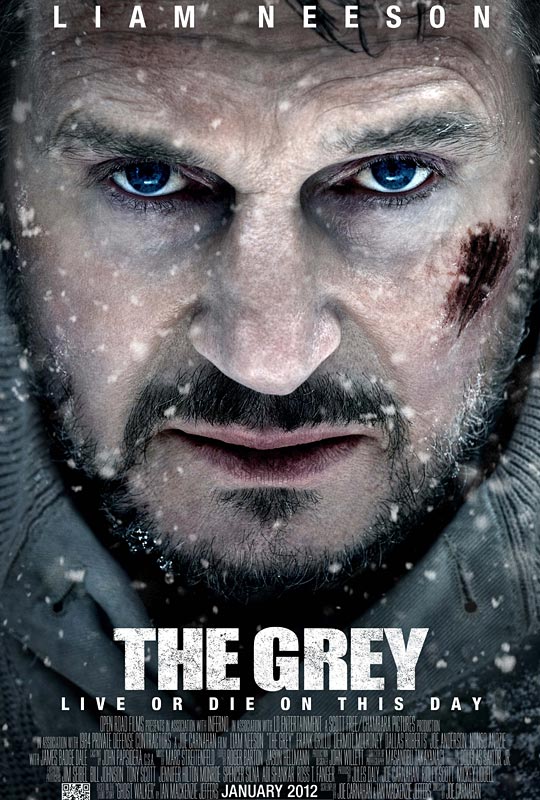
Baby, I'm Howlin' For You: A Review of The Grey
Movie trailers can very misleading, and the trailer for The Grey, the newest film to feature Liam Neeson kicking ass (becoming a nice little sub-genre of its own), is no exception: near the end of the preview--which has been on every television station every five minutes for the past month--Neeson's character, Ottway, constructs a homemade version of brass knuckles made out of broken mini liquor bottles (known in my neck of the woods as "nips") and tape, ready to take on a wolf snarling in his direction. The fight that is sure to follow is never shown in the film. Pretend someone asked me this question outside of the movie theater: "Do you think you will enjoy The Grey if Liam Neeson doesn't punch a wolf in the face with shards of glass stuck to his hand?" My answer would have been a resounding "no". Thankfully, I was wrong. The Grey is an early bright spot in the year 2012, a film that is manly, exciting, thoughtful and had me completely transfixed throughout the entire run time.
Ottway works for an oil company that is based is the freezing-cold far north. He's a sharp shooter that keeps wolves away from the equipment and other employees. The Grey begins with a voice over of Ottway describing the dreadful situation: most of the oil drillers are ex-cons and violent men, cut off from the rest of the world. Not many have any redeemable qualities, at least at first. It's almost like an art-house film at the beginning, with Ottway's calm voice, the freezing cold and snow, and flash-backs of Ottway in bed with with his wife, clearly the only person in the world that means anything to him.
Ottway and a plethora of other workers enter a plane to fly out on leave. It's stormy, and the dread builds quickly as things start going wrong with the flight. What follows is an extremely disturbing and intense plane crash (this isn't giving anything away if you've seen five seconds of any of the trailers). Seriously, I would not watch this if I were flying on a plane anytime soon--the sound effects are particularly great. Seven men are left alive, but that number quickly dwindles once one gets brutally attacked by a ferocious wolf.
The film reminded me of me of 1982's John Carpenter version of The Thing, an absolute classic of isolation and horror. With only a few main characters who are cut off from the outside world, each individual is original and well-developed. There's plenty of time for conversation for the men while they wait out winter's elements and wolf attacks, filled with philosophy and discussions on life and (especially) death. We learn the most back story on Ottway, who was contemplating suicide the day before the fateful plane crash. The wolves, not unlike the alien creature in The Thing, are terrifying, violent and smart. They hunt in formations, take out the stragglers fist, and try to outsmart their potential prey instead of overpower them. As Ottway takes the reigns of the situation and becomes somewhat of a leader, he knows they must take down these creatures if they want to stand a chance. But they are also fighting an even more powerful foe: weather--ice, blizzards, and high winds smother the treacherous terrain.
At one point in the film, Ottway--after seeing and suffering terrible things--calls out to above, begging for help. The camera focuses on the blank sky, looking for an answer. There is, obviously, no response. And there wouldn't be in The Grey, a film that's honest and philosophical in its questions of faith and the notion that a God could put humans in circumstances are terrible as this. Each man must come to grips with his own potential fate, and--God-fearing or not--the wolves continue to attack and winter's weather keeps building layer upon layer of dread and snow. (A-)
Ottway works for an oil company that is based is the freezing-cold far north. He's a sharp shooter that keeps wolves away from the equipment and other employees. The Grey begins with a voice over of Ottway describing the dreadful situation: most of the oil drillers are ex-cons and violent men, cut off from the rest of the world. Not many have any redeemable qualities, at least at first. It's almost like an art-house film at the beginning, with Ottway's calm voice, the freezing cold and snow, and flash-backs of Ottway in bed with with his wife, clearly the only person in the world that means anything to him.
Ottway and a plethora of other workers enter a plane to fly out on leave. It's stormy, and the dread builds quickly as things start going wrong with the flight. What follows is an extremely disturbing and intense plane crash (this isn't giving anything away if you've seen five seconds of any of the trailers). Seriously, I would not watch this if I were flying on a plane anytime soon--the sound effects are particularly great. Seven men are left alive, but that number quickly dwindles once one gets brutally attacked by a ferocious wolf.
The film reminded me of me of 1982's John Carpenter version of The Thing, an absolute classic of isolation and horror. With only a few main characters who are cut off from the outside world, each individual is original and well-developed. There's plenty of time for conversation for the men while they wait out winter's elements and wolf attacks, filled with philosophy and discussions on life and (especially) death. We learn the most back story on Ottway, who was contemplating suicide the day before the fateful plane crash. The wolves, not unlike the alien creature in The Thing, are terrifying, violent and smart. They hunt in formations, take out the stragglers fist, and try to outsmart their potential prey instead of overpower them. As Ottway takes the reigns of the situation and becomes somewhat of a leader, he knows they must take down these creatures if they want to stand a chance. But they are also fighting an even more powerful foe: weather--ice, blizzards, and high winds smother the treacherous terrain.
At one point in the film, Ottway--after seeing and suffering terrible things--calls out to above, begging for help. The camera focuses on the blank sky, looking for an answer. There is, obviously, no response. And there wouldn't be in The Grey, a film that's honest and philosophical in its questions of faith and the notion that a God could put humans in circumstances are terrible as this. Each man must come to grips with his own potential fate, and--God-fearing or not--the wolves continue to attack and winter's weather keeps building layer upon layer of dread and snow. (A-)
Thursday, January 26, 2012
Though Fassbender Hangs Dong, It's Tough to Get Super Aroused Over Shame
Director Steve McQueen's first film, Hunger, was released in 2008 to critical and film festival acclaim. It also starred Michael Fassbender, portraying Bobby Sands, an IRA member who started a hunger strike in prison (along with a no-wash protest). Sands was a Republican trying to regain political status when, in 1976, the British Government took it away. The film was honest and brutal and filmed in such an unflinching way that it was impossible to look in the other direction, no matter how badly you might like to. McQueen's second and newest film, Shame, is profoundly similar: starring Michael Fassbender as a sex addict whose sole purpose in life seems to be reaching sexual climax, the film shows an honest portrait of an addict throughout every dirty, shameful and pleasure-inducing moment in his daily life. It's a tough but worthwhile watch.
Brandon (Fassbender) is a man in his 30's living in a clean and bright (you can almost smell the Lysol and Scrubbing Bubbles) apartment in New York City. He works with a computer all day long for an upscale company that deals with stocks or whatever. The viewer doesn't really care what Brandon does for a job, because Brandon doesn't care what he does for a job. The only jobs he cares about is hand and blow--maybe foot too, but the film doesn't delve that far into unique fetishes. Brandon wakes up in the morning and jerks off in the shower. He goes to work and uses the bathroom stall to conceal his masturbation. He gets home from work, immediately opens his laptop and cuffs it to live porno video feeds. Sometimes he goes out with his boss and picks up girls who he fucks in various locations, positions and holes. It does not matter to Brandon. Getting off is his only way to get through the day.
Shame is not funny (at least not in the LOL! sense), nor is it supposed to be. Brandon's addiction is treated the same as a heroin user or a crack fiend. At first he has it somewhat in control (if you can call wanking it at work under control), but that all changes once his sister, Sissy (played wonderfully incestuous and needy by Carey Mulligan, the it-girl of indie films lately), re-enters his life and starts crashing at his apartment, which consequently crashes the perfected routine of Brandon's orgasm-obsessed life. Like most addicts, thing's fall into a downward spiral quickly once he stops getting exactly what he want's when he wants it.
Shame isn't like most theatrical films dealing with sex. For instance, it's rated the dreaded (for box-office earnings) NC-17. The only reason it expanded to more than a few select cities is because of it's attention by the awards season ceremonies and the unflinching performances. And boy does it earn its NC-17 rating: filled with penis, pussy and dozens of minutes of intense sexual encounters of varying degree and danger, Shame isn't going to be a big hit among people who get uncomfortable looking at naked bodies (religious people). There are also scenes of extremely graphic sexual talk and there's even some homosexual plowing and blowjobs, so if that sort of thing offends you (religious people), Shame isn't a good choice for your Friday night movie.
The film is--obviously--buoyed by Fassbender's performance and McQueen's direction. For being an art-house type movie director, McQueen is good at staying away from the normal pretentiousness that can bog down many a film. He shows a scene, and we form our own opinions. There are no political ideals present, no hatred towards its characters, no viewpoints other than what our eyes can see. Shame looks slick, and every camera angle looks like it perfectly fits into the bigger puzzle of the whole film. The camera staying on Brandon's face during an intense climax, the camera spinning to show the engagement ring of a flirtatious girl, the camera fixating on a broken don't walk sign--all of these are equally important and all mean something.
Fassbender: wow, that man has some testicular fortitude to take on a role such as this. The movie, at its center, is about suffering. Suffering from an addiction that can't be tamed, no matter how many times Brandon gets off on a given day. We see him at his most private, embarrassing moments, and the great Fassbender acts them out with honesty and skill. Get this man some recognition. However, there is a bigger question when it comes to Shame: is it enjoyable? Well, that just depends on what your idea of enjoyable really is. It's all relative. If you enjoy good film making, acting, and stories about addiction, the film should be just your cup of tea. If you don't enjoy depressing, tough films about real subject matter, I'd suggest grabbing a ticket for another film (I hear Red Tails is out). Me: Shame is great, Shame is intense, but Shame is a tough watch. I respected it and liked it a whole lot, but wouldn't go far enough to say I loved it. (B)
Brandon (Fassbender) is a man in his 30's living in a clean and bright (you can almost smell the Lysol and Scrubbing Bubbles) apartment in New York City. He works with a computer all day long for an upscale company that deals with stocks or whatever. The viewer doesn't really care what Brandon does for a job, because Brandon doesn't care what he does for a job. The only jobs he cares about is hand and blow--maybe foot too, but the film doesn't delve that far into unique fetishes. Brandon wakes up in the morning and jerks off in the shower. He goes to work and uses the bathroom stall to conceal his masturbation. He gets home from work, immediately opens his laptop and cuffs it to live porno video feeds. Sometimes he goes out with his boss and picks up girls who he fucks in various locations, positions and holes. It does not matter to Brandon. Getting off is his only way to get through the day.
Shame is not funny (at least not in the LOL! sense), nor is it supposed to be. Brandon's addiction is treated the same as a heroin user or a crack fiend. At first he has it somewhat in control (if you can call wanking it at work under control), but that all changes once his sister, Sissy (played wonderfully incestuous and needy by Carey Mulligan, the it-girl of indie films lately), re-enters his life and starts crashing at his apartment, which consequently crashes the perfected routine of Brandon's orgasm-obsessed life. Like most addicts, thing's fall into a downward spiral quickly once he stops getting exactly what he want's when he wants it.
Shame isn't like most theatrical films dealing with sex. For instance, it's rated the dreaded (for box-office earnings) NC-17. The only reason it expanded to more than a few select cities is because of it's attention by the awards season ceremonies and the unflinching performances. And boy does it earn its NC-17 rating: filled with penis, pussy and dozens of minutes of intense sexual encounters of varying degree and danger, Shame isn't going to be a big hit among people who get uncomfortable looking at naked bodies (religious people). There are also scenes of extremely graphic sexual talk and there's even some homosexual plowing and blowjobs, so if that sort of thing offends you (religious people), Shame isn't a good choice for your Friday night movie.
The film is--obviously--buoyed by Fassbender's performance and McQueen's direction. For being an art-house type movie director, McQueen is good at staying away from the normal pretentiousness that can bog down many a film. He shows a scene, and we form our own opinions. There are no political ideals present, no hatred towards its characters, no viewpoints other than what our eyes can see. Shame looks slick, and every camera angle looks like it perfectly fits into the bigger puzzle of the whole film. The camera staying on Brandon's face during an intense climax, the camera spinning to show the engagement ring of a flirtatious girl, the camera fixating on a broken don't walk sign--all of these are equally important and all mean something.
Fassbender: wow, that man has some testicular fortitude to take on a role such as this. The movie, at its center, is about suffering. Suffering from an addiction that can't be tamed, no matter how many times Brandon gets off on a given day. We see him at his most private, embarrassing moments, and the great Fassbender acts them out with honesty and skill. Get this man some recognition. However, there is a bigger question when it comes to Shame: is it enjoyable? Well, that just depends on what your idea of enjoyable really is. It's all relative. If you enjoy good film making, acting, and stories about addiction, the film should be just your cup of tea. If you don't enjoy depressing, tough films about real subject matter, I'd suggest grabbing a ticket for another film (I hear Red Tails is out). Me: Shame is great, Shame is intense, but Shame is a tough watch. I respected it and liked it a whole lot, but wouldn't go far enough to say I loved it. (B)
Monday, January 23, 2012
Filled with Star Power, Haywire Provides an Erratic Ride
Very soon after the previews roll, the lights in the theater fade to darkness, and everyone gets settled into their seats for director Steven Soderbergh's newest film, Haywire, Mallory Kane--portrayed by MMA super-fighter Gina Carano--is getting scalding-hot coffee tossed into her face and a man's powerful fists smashing her head against the floor. It's a surprising and brutal start to the film, but one that is effective in relaying a message to the audience: be ready for a film with no-holds-barred realistic violence against both sexes, a film that's trying to avoid typical action movie predictability. In that regard, it (mostly) succeeds: Haywire is 2012's first film worth seeing, a film that is solely based around Gina Carano's impressive and sexy martial arts skills and not too concerned about plot or plausibility (and it doesn't need to be).
The plot is basically construed to be a variety of scenes that put Mallory in jeopardy. She's an employee of a secret government agency, an agency that sends people into various exotic locales to retrieve items, shoot bad guys, and free hostages. Haywire starts in the present, with Mallory on the run, and much of the film is arranged in flashbacks showing how the smart agent is in her current dire situation. She gets betrayed by a myriad of people at every turn, and one has to think how this agency has survived as long as it has with all of the double crossing. After a mysterious mission in Barcelona, Mallory isn't even finished unpacking before her boss sends her on another mission, one that is supposed to be a cakewalk. This sets off a chain of events that leaves behind many bloody bodies and bruised faces.
Though--as I stated before--the film is basically a showcase for Gina Carano's fighting skills, what a damn good cast Haywire has. Mallory's ex-boyfriend and the firm's director, Kenneth, is portrayed by Ewan McGregor (who has shown his great range lately in The Ghost Writer and Beginners), clearly relishing his role as a man of power with questionable morals. Mallory and Kenneth have been hired for the dangerous mission by Government agent Coblenz, portrayed by Michael Douglas in his typical charming yet snaky characterization. His contact is Rodrigo, played by Antonio Banderas as a rich man who may be in over his head. Bill Paxton is Mallory's dad, John, the only person she can trust, a man in which every situation is analyzed with a militaristic mentality in his mind. The ever-watchable Michael Fassbender portrays a British agent with an agenda of his own. It's quite amazing that Soderbergh has wrangled in a cast such as this, because many of them are just bit characters who are present to be punching bags instead of a showcase of acting ability.
The best part of Haywire is a breath of fresh air compared to most of the hundreds of generic action films that come out every year. The fight scenes seem extremely realistic and feel much more painful than typical fighting fare. There's a reason for this: the elaborate and technical fight scenes are mostly filmed with static camera angles that allow the viewer to really watch. This isn't like the Bourne movies, where the quick camera cutting from punch to kick make Matt Damon's ability seem faster than lightning striking. These fights are damn real: they're slower and more controlled, and there are lulls in the action where the actors gather themselves before going in for more. Give credit to the cast for taking a beating, because--after watching the one-after-another fight scenes in Haywire--it's easy to guarantee that they were extremely sore and bruised the next day.
Is Gina Carano the "next big thing" in female action stars? That's a tougher question. Though she clearly isn't a wonderful actress yet (most of the scenes which involve her in dialogue don't work as well as her giving an ass-kicking), Haywire is a great showcase of her screen presence, stamina, and sexuality. I could see her getting better and better if she decides to pursue a career in acting instead of beating real women to near-death. Though the film has an anorexic-thin story and is basically just a good distraction for a snowy winter afternoon, Haywire succeeds in what it sets out to do: become a top-of-the-line genre action film that puts more stock into style than into substance. (B)
The plot is basically construed to be a variety of scenes that put Mallory in jeopardy. She's an employee of a secret government agency, an agency that sends people into various exotic locales to retrieve items, shoot bad guys, and free hostages. Haywire starts in the present, with Mallory on the run, and much of the film is arranged in flashbacks showing how the smart agent is in her current dire situation. She gets betrayed by a myriad of people at every turn, and one has to think how this agency has survived as long as it has with all of the double crossing. After a mysterious mission in Barcelona, Mallory isn't even finished unpacking before her boss sends her on another mission, one that is supposed to be a cakewalk. This sets off a chain of events that leaves behind many bloody bodies and bruised faces.
Though--as I stated before--the film is basically a showcase for Gina Carano's fighting skills, what a damn good cast Haywire has. Mallory's ex-boyfriend and the firm's director, Kenneth, is portrayed by Ewan McGregor (who has shown his great range lately in The Ghost Writer and Beginners), clearly relishing his role as a man of power with questionable morals. Mallory and Kenneth have been hired for the dangerous mission by Government agent Coblenz, portrayed by Michael Douglas in his typical charming yet snaky characterization. His contact is Rodrigo, played by Antonio Banderas as a rich man who may be in over his head. Bill Paxton is Mallory's dad, John, the only person she can trust, a man in which every situation is analyzed with a militaristic mentality in his mind. The ever-watchable Michael Fassbender portrays a British agent with an agenda of his own. It's quite amazing that Soderbergh has wrangled in a cast such as this, because many of them are just bit characters who are present to be punching bags instead of a showcase of acting ability.
The best part of Haywire is a breath of fresh air compared to most of the hundreds of generic action films that come out every year. The fight scenes seem extremely realistic and feel much more painful than typical fighting fare. There's a reason for this: the elaborate and technical fight scenes are mostly filmed with static camera angles that allow the viewer to really watch. This isn't like the Bourne movies, where the quick camera cutting from punch to kick make Matt Damon's ability seem faster than lightning striking. These fights are damn real: they're slower and more controlled, and there are lulls in the action where the actors gather themselves before going in for more. Give credit to the cast for taking a beating, because--after watching the one-after-another fight scenes in Haywire--it's easy to guarantee that they were extremely sore and bruised the next day.
Is Gina Carano the "next big thing" in female action stars? That's a tougher question. Though she clearly isn't a wonderful actress yet (most of the scenes which involve her in dialogue don't work as well as her giving an ass-kicking), Haywire is a great showcase of her screen presence, stamina, and sexuality. I could see her getting better and better if she decides to pursue a career in acting instead of beating real women to near-death. Though the film has an anorexic-thin story and is basically just a good distraction for a snowy winter afternoon, Haywire succeeds in what it sets out to do: become a top-of-the-line genre action film that puts more stock into style than into substance. (B)
Thursday, January 12, 2012
Glitter among the Chickenfeed: Tinker Tailor Soldier Spy is Tailored to be One of the Best of the Year
You can count on confusion setting in early in the run time of Tinker Tailor Soldier Spy, the 2011 film directed by Tomas Alfredson, (who surprisingly also directed the great Let the Right One In). It's the common--and correct--reaction: characters wander from one dreary place to another, entering a dark room or answering a phone, and the scenes deftly switch to the next just as--one would think--the previous scene was just beginning. It's an interesting technique, but it works beautifully in making the viewer realize what type of film he/she is watching: a paranoid story about confusion and espionage. Starring a subdued and wonderful Gary Oldman, Tinker Tailor Soldier Spy is, if you have a little patience and can understand thick British accents, a little gem of a film that ranks among some of the year's best.
The plot is complicated for those who haven't read the the 1974 spy novel of the same name by John le Carre. I'll try and simplify the best I can: it's the height of the Cold War. A Soviet spy is supposedly embedded within the MI6 (the British intelligence agency). This so-called "mole" is (probably) one of six men who can make significant decisions at the top of the food chain of MI6, code named The Circus. The cast is incredible, a total who's who of great actors that are legends or are quickly on their way.
Mr. Smiley (Oldman) has recently been forced into retirement, but accepts a job to quietly try to find out who is releasing life-or-death information. Oldman plays it calm and collected, but he's a man that cuts through all of the shit to get the correct intelligence. Smiley's partner, the young up-and-comer Peter, is an inside man who seemingly will do anything to satisfy Smiley. Peter is portrayed by Benedict Cumberbatch, a face we'll sure be seeing a lot more of due to the fact that he will be the next villain in the coming Star Trek sequel. Colin Firth, Ciaran Hinds, and Toby Jones are also possible suspects. All of these great names, and still some of the best scenes of the movie are acted out by the (awe-inspiring) Tom Hardy, playing an on-the-run agent with too much information, and Mark Strong (great in The Guard) an agent on a fool's errand who may or may not have been assassinated.
Before you get too excited about all of the potential for violence and chase scenes, let me warn you: James Bond this ain't. Where the 007 films create excitement through bullets, fisticuffs, and gadgets, Tinker Tailor Soldier Spy creates excitement through harsh words, the threat of harm or torture, and tension that--like the film's fog, rain and dreariness--never breaks. The majority of the violence takes place off screen. This is a film about mood and words, where men in trench coats walk into rain-covered alleys and dank homes and have conversations and arguments that go in circles and never quite let you in on the secret of who the mole really is. It's the opposite of a terrible film such as Fast Five, which I, very unfortunately, viewed the following evening.
Among the heaping of praise, Tinker Tailor Soldier Spy does have some detriments: it's nearly impossible to fully comprehend every event that happens in the film if you're not already familiar with the book, especially in the first third of the film. Soon after we barely meet the characters, many of them seem quite suspicious even though we don't know enough about them to have an opinion one way or the other. The cast is huge, and keeping track of names and locations doesn't quite become a chore, but it is certainly difficult nonetheless. Overall, though, the film works. Anchored by the calming performance of Gary Oldman, the amazingly realistic settings and tones, the exciting smaller roles of Tom Hardy and Mark Strong, and the tension that slowly fills every scene like rain in a clogged gutter, Tinker Tailor Soldier Spy is a puzzle of paranoia that I couldn't help try to figure out. (A-)
The plot is complicated for those who haven't read the the 1974 spy novel of the same name by John le Carre. I'll try and simplify the best I can: it's the height of the Cold War. A Soviet spy is supposedly embedded within the MI6 (the British intelligence agency). This so-called "mole" is (probably) one of six men who can make significant decisions at the top of the food chain of MI6, code named The Circus. The cast is incredible, a total who's who of great actors that are legends or are quickly on their way.
Mr. Smiley (Oldman) has recently been forced into retirement, but accepts a job to quietly try to find out who is releasing life-or-death information. Oldman plays it calm and collected, but he's a man that cuts through all of the shit to get the correct intelligence. Smiley's partner, the young up-and-comer Peter, is an inside man who seemingly will do anything to satisfy Smiley. Peter is portrayed by Benedict Cumberbatch, a face we'll sure be seeing a lot more of due to the fact that he will be the next villain in the coming Star Trek sequel. Colin Firth, Ciaran Hinds, and Toby Jones are also possible suspects. All of these great names, and still some of the best scenes of the movie are acted out by the (awe-inspiring) Tom Hardy, playing an on-the-run agent with too much information, and Mark Strong (great in The Guard) an agent on a fool's errand who may or may not have been assassinated.
Before you get too excited about all of the potential for violence and chase scenes, let me warn you: James Bond this ain't. Where the 007 films create excitement through bullets, fisticuffs, and gadgets, Tinker Tailor Soldier Spy creates excitement through harsh words, the threat of harm or torture, and tension that--like the film's fog, rain and dreariness--never breaks. The majority of the violence takes place off screen. This is a film about mood and words, where men in trench coats walk into rain-covered alleys and dank homes and have conversations and arguments that go in circles and never quite let you in on the secret of who the mole really is. It's the opposite of a terrible film such as Fast Five, which I, very unfortunately, viewed the following evening.
Among the heaping of praise, Tinker Tailor Soldier Spy does have some detriments: it's nearly impossible to fully comprehend every event that happens in the film if you're not already familiar with the book, especially in the first third of the film. Soon after we barely meet the characters, many of them seem quite suspicious even though we don't know enough about them to have an opinion one way or the other. The cast is huge, and keeping track of names and locations doesn't quite become a chore, but it is certainly difficult nonetheless. Overall, though, the film works. Anchored by the calming performance of Gary Oldman, the amazingly realistic settings and tones, the exciting smaller roles of Tom Hardy and Mark Strong, and the tension that slowly fills every scene like rain in a clogged gutter, Tinker Tailor Soldier Spy is a puzzle of paranoia that I couldn't help try to figure out. (A-)
Sunday, January 8, 2012
Netflix This: Beginners
Beginners is about Hal and Oliver, a father and son who find love in unlikely places. The woman in their lives (wife, mother), Georgia, has recently died, and Hal has a curious confession: "I'm Gay." So begins the story of this loving father and son's second chance at happiness. Hal and Georgia had been married for 38 years, so the news is a shock to Oliver, who has relationship problems of his own, never being able to make a connection with anyone meaningful.
Both find a new meaning in life when opening up to others about their true thoughts, feelings and convictions. Hal has found a new boyfriend, and is absolutely joyous at the thought of actually being able to live a gay lifestyle out in the open, no longer confined to the standards and morals of a heterosexual marriage. Christopher Plummer, sure to be recognized for this small but great role during awards season, portrays Hal as an extremely loving and caring man. He dances, drinks great wine, attends parties with flash and flair, all the while concealing to everyone that he is dying of cancer other than a select few loved ones. Oliver meets a new girl at a costume party, the first encounter being cute and eccentric, due to new girl's laryngitis. New girl is Anna, portrayed by Inglorious Basterd's Melanie Laurent as a woman with plenty of beauty, uniqueness and distance to keep Oliver interested. Ewan McGregor portrays Oliver with a charming sadness, one who finds it hard to be truly happy in a world that doesn't make much sense.
Three time lines make up Beginners, seamlessly changing between Oliver's childhood memories of spending time with his mother, the hard time with Anna after his father's death, and the short period of time where Hal finally came out of the closet and enjoyed his gay lifestyle. This doesn't ruin the story: it's about the journey rather than the outcome. Beginners is about people just trying to be happy, whether they have their entire, fruitful lives ahead of them or only a couple of months left to live. Certain scenes in Beginners involve Hal's dog, Arthur, whom Oliver has grown to think of as a loving friend and companion. We read what Arthur is barking and thinking, because it's subtitled into the English language. He, like most dogs wouldn't be, isn't concerned with opinions or emotions and tells things how they are. Thankfully, Beginners is the same way: it's simple and effective, and shows us the love and lives of two characters who have been hiding in one metaphorical closet or another.
Both find a new meaning in life when opening up to others about their true thoughts, feelings and convictions. Hal has found a new boyfriend, and is absolutely joyous at the thought of actually being able to live a gay lifestyle out in the open, no longer confined to the standards and morals of a heterosexual marriage. Christopher Plummer, sure to be recognized for this small but great role during awards season, portrays Hal as an extremely loving and caring man. He dances, drinks great wine, attends parties with flash and flair, all the while concealing to everyone that he is dying of cancer other than a select few loved ones. Oliver meets a new girl at a costume party, the first encounter being cute and eccentric, due to new girl's laryngitis. New girl is Anna, portrayed by Inglorious Basterd's Melanie Laurent as a woman with plenty of beauty, uniqueness and distance to keep Oliver interested. Ewan McGregor portrays Oliver with a charming sadness, one who finds it hard to be truly happy in a world that doesn't make much sense.
Three time lines make up Beginners, seamlessly changing between Oliver's childhood memories of spending time with his mother, the hard time with Anna after his father's death, and the short period of time where Hal finally came out of the closet and enjoyed his gay lifestyle. This doesn't ruin the story: it's about the journey rather than the outcome. Beginners is about people just trying to be happy, whether they have their entire, fruitful lives ahead of them or only a couple of months left to live. Certain scenes in Beginners involve Hal's dog, Arthur, whom Oliver has grown to think of as a loving friend and companion. We read what Arthur is barking and thinking, because it's subtitled into the English language. He, like most dogs wouldn't be, isn't concerned with opinions or emotions and tells things how they are. Thankfully, Beginners is the same way: it's simple and effective, and shows us the love and lives of two characters who have been hiding in one metaphorical closet or another.
Friday, December 23, 2011
Dark, Dreary and Disturbing: Dragon Tattoo Becomes Another Must Watch from David Fincher
Many of my (not very smart) friends would claim that I don't like anything that is popular, and I would even go out of the way to not watch, read, or listen to something if too many people like it. This statement is usually wrong. When it came to Stieg Larsson's bestselling "Millennium" trilogy--which begins with the book The Girl with the Dragon Tattoo--the statement rings more true: at one point in time in the past couple of years, it seemed like every living human was reading one of the three books, with their colorful covers and unique titles.
So I decided not to read the books, particularly once I learned that David Fincher was adapting the first book of the trilogy into a film (same title). My thought: Fincher, one of the best directors working today, would make the story the best version possible. I still haven't read the books (though after watching the film my interest has risen), so I cannot attest to the versions of the characters, plot points, plot twists or narrative of Larsson's written word. There will not be any comparisons here. What I'm sure of is simple: Fincher has created another great film, continuing that trend from last year's incredible The Social Network. It's brutal, doesn't hold back any punches, and although the climax comes quickly and is a little less exciting than I expected, the American film version of The Girl with the Dragon Tattoo is one of the year's best, anchored by Fincher's deft direction, Trent Reznor's beautiful and haunting soundtrack, and Rooney Mara's star-making turn as the wounded and wound-giving Lisbeth Salander.
The story is extremely complicated at first for the uninitiated (me). Remember the first scene of The Social Network where Mark Zuckerberg and his girlfriend (who is actually played by Rooney Mara, if you can believe it) are talking fast and hurtful? Words fly by at a bullet's pace, snapping and insinuating in a sarcastic tone. The first part of Dragon Tattoo is like this too, except its about libel and a murder investigation and everyone is speaking in a Swedish accent. The basics: Mikael Blomkvist (Daniel Craig, looking disheveled and tired), a journalist/publisher who does stories for Millennium magazine, loses a libel case against a man named Erik Wennerstrom with money to burn. He's in trouble, and his reputation has been flushed down the shitter. Soon after, he's invited to an island by a man named Henrik Vanger. Vanger knows that it would be beneficial for Blomkvist to leave town and let the dust settle after his court case, so he commissions Blomkvist to investigate the disappearance of his great niece Harriet, who wandered off 36 years ago never to be heard from again. Vanger will pay him double his normal salary and even give him some inside information about Wennerstrom (that would help overturn the libel case) if he figures out what happened to Harriet. Commence the murder mystery.
Throughout all of this, we meet Lisbeth Salander, an asocial gender-bending badass who is an expert at computer hacking and surveillance. Lisbeth and Mikael's paths cross when Mikael realizes that Lisbeth's talents would be extremely beneficial to the investigation of a family that lives cut off to the outside world (on the cold, snowy island) and hold secrets like lovers hold hands. As Lisbeth and Mikael's relationship grows, so do the lies and complex plot twists involving the Vanger family and that fateful day 36 years ago when Harriet either went missing, ran away from home, or was murdered.
Girls kicking ass: it holds a soft spot in my heart. Clearly more audiences want an interesting female heroine to root for, myself included. Men shooting each other and uttering corny catchphrases is only interesting for so long. Lisbeth, surely, is one of the best female characters of the year. A self-admitted psycho, she is a ward of the state due to her violence and anti-social behavior. As previously stated, The Girl with the Dragon Tattoo is brutal. Most of that brutality deals with Lisbeth and men that take her strength for granted. Her scenes are not for the weak of heart: they involved forced blowjobs, anal rape and extreme violence. She's had a tough life, and we know that because it's depicted with a wounded ferocity by Rooney Mara. Every sarcastic reply, tear, scream and expression of sadness is portrayed brilliantly by the total physical transformation and acting of this great young actress. Her ability anchors the sometimes disjointed plot and occasionally predictable twists.
The Girl with the Dragon Tattoo isn't David Fincher's best directorial effort. But that doesn't especially say much, considering he made the classics Seven, Fight Club, and The Social Network. It's still one of my favorites this year, even if when you take away all of the stylistic flourishes, awesome acting and setting the story boils down to a murder mystery that would be right at home in a show like AMC's The Killing. But that's okay, though: the dark direction is impeccable, the pacing incredible, the acting awe-inspiring. When the credits roll on the other two stories in Lisbeth Salander's trilogy, The Girl who Played with Fire and The Girl who Kicked the Hornet's Nest, my only hope is that the same cast, crew, producers and musicians are listed, because I surely will have been wowed again. (A-)
So I decided not to read the books, particularly once I learned that David Fincher was adapting the first book of the trilogy into a film (same title). My thought: Fincher, one of the best directors working today, would make the story the best version possible. I still haven't read the books (though after watching the film my interest has risen), so I cannot attest to the versions of the characters, plot points, plot twists or narrative of Larsson's written word. There will not be any comparisons here. What I'm sure of is simple: Fincher has created another great film, continuing that trend from last year's incredible The Social Network. It's brutal, doesn't hold back any punches, and although the climax comes quickly and is a little less exciting than I expected, the American film version of The Girl with the Dragon Tattoo is one of the year's best, anchored by Fincher's deft direction, Trent Reznor's beautiful and haunting soundtrack, and Rooney Mara's star-making turn as the wounded and wound-giving Lisbeth Salander.
The story is extremely complicated at first for the uninitiated (me). Remember the first scene of The Social Network where Mark Zuckerberg and his girlfriend (who is actually played by Rooney Mara, if you can believe it) are talking fast and hurtful? Words fly by at a bullet's pace, snapping and insinuating in a sarcastic tone. The first part of Dragon Tattoo is like this too, except its about libel and a murder investigation and everyone is speaking in a Swedish accent. The basics: Mikael Blomkvist (Daniel Craig, looking disheveled and tired), a journalist/publisher who does stories for Millennium magazine, loses a libel case against a man named Erik Wennerstrom with money to burn. He's in trouble, and his reputation has been flushed down the shitter. Soon after, he's invited to an island by a man named Henrik Vanger. Vanger knows that it would be beneficial for Blomkvist to leave town and let the dust settle after his court case, so he commissions Blomkvist to investigate the disappearance of his great niece Harriet, who wandered off 36 years ago never to be heard from again. Vanger will pay him double his normal salary and even give him some inside information about Wennerstrom (that would help overturn the libel case) if he figures out what happened to Harriet. Commence the murder mystery.
Throughout all of this, we meet Lisbeth Salander, an asocial gender-bending badass who is an expert at computer hacking and surveillance. Lisbeth and Mikael's paths cross when Mikael realizes that Lisbeth's talents would be extremely beneficial to the investigation of a family that lives cut off to the outside world (on the cold, snowy island) and hold secrets like lovers hold hands. As Lisbeth and Mikael's relationship grows, so do the lies and complex plot twists involving the Vanger family and that fateful day 36 years ago when Harriet either went missing, ran away from home, or was murdered.
Girls kicking ass: it holds a soft spot in my heart. Clearly more audiences want an interesting female heroine to root for, myself included. Men shooting each other and uttering corny catchphrases is only interesting for so long. Lisbeth, surely, is one of the best female characters of the year. A self-admitted psycho, she is a ward of the state due to her violence and anti-social behavior. As previously stated, The Girl with the Dragon Tattoo is brutal. Most of that brutality deals with Lisbeth and men that take her strength for granted. Her scenes are not for the weak of heart: they involved forced blowjobs, anal rape and extreme violence. She's had a tough life, and we know that because it's depicted with a wounded ferocity by Rooney Mara. Every sarcastic reply, tear, scream and expression of sadness is portrayed brilliantly by the total physical transformation and acting of this great young actress. Her ability anchors the sometimes disjointed plot and occasionally predictable twists.
The Girl with the Dragon Tattoo isn't David Fincher's best directorial effort. But that doesn't especially say much, considering he made the classics Seven, Fight Club, and The Social Network. It's still one of my favorites this year, even if when you take away all of the stylistic flourishes, awesome acting and setting the story boils down to a murder mystery that would be right at home in a show like AMC's The Killing. But that's okay, though: the dark direction is impeccable, the pacing incredible, the acting awe-inspiring. When the credits roll on the other two stories in Lisbeth Salander's trilogy, The Girl who Played with Fire and The Girl who Kicked the Hornet's Nest, my only hope is that the same cast, crew, producers and musicians are listed, because I surely will have been wowed again. (A-)
Sunday, December 18, 2011
Choose to Accept Mission Impossible: Ghost Protocol
After John Woo's crapfest Mission Impossible II, the already-getting-tired series took a new direction as TV wonder boy J. J. Abrams took the helm. It was a great success: Ethan Hunt's adventures turned darker and more serious, predominantly due to Abram's directing efforts and Philip Seymour Hoffman's scary turn as a villain with no mercy. (Is there any other kind in films like these?) For Mission Impossible: Ghost Protocol (MI:GP), Abrams and his producing company handed over the franchise to another exciting director, Brad Bird, making his first live-action film after three animated classics: The Iron Giant and Pixar's The Incredibles and Ratatouille. The jump to real life is a smooth one: Bird and the new and returning cast have created one of the most exciting, vertigo-inducing, action-packed films of the year.
You've all seen the advertising (and the movie poster to the right). It has Cruise dangling off the tallest building in the world, the Burj Khalifa in Dubai, wearing gloves that would make Spiderman shoot sticky white stuff. I almost shot out a different bodily fluid because of some of the incredible IMAX-camera-shot scenes that are not for the faint of heart if you're not a big fan of heights. It's the movie's best action set piece, and MI:GP is full of them: an elaborate prison break set to the soothing voice of Dean Martin, a break-in to the inside of the Kremlin in Russia (involving some of the most creative gadgetry seen in these types of spy films), a lavish party set in a mansion in Mumbai--they're all here, and they're all, particularly in IMAX, breathtaking to behold.
The plot is typical and not especially important, which is one of the few detriments of the film. It involves the typical foreign baddie looking for nuclear codes, nuclear devices, nuclear anything. The world will end unless the IMF team stops it. It's not hard to imagine the climax of the film involving a countdown and a missile flying through the air. It does, however, have one cool twist: after a bombing at the Kremlin in Russia, the U. S. Government initiates "Ghost Protocol" (hence the title), in which they denounce any undercover agency. The IMF team is alone and in the dark.
That leaves Hunt to lead his team through various exotic locations of the world. The characters are more interesting than typical: Simon Pegg is back in the role of Benji, and he gets to flash much more than his wit this time around (though he is the most amusing of the characters). Paula Patton is the feisty, big-breasted Jane who is out for revenge after her lover--another agent--is killed by a woman assassin. Nothing like a little girl-on-girl. Jeremy Renner, who lately seems to be great in any scene that he acts in, is the best new addition; he's a calm bad-ass with secrets that plays as a nice foil to Cruise's more frantic, nervous Ethan Hunt. They all have integral roles in each action set-piece, playing off of each other like a cast that has been together through numerous sequels.
You would never guess that this was Brad Bird's first live-action directorial movie. But it does make sense: many animated films have high-action (particularly the ones that Bird has directed in the past). Like The Incredibles, Mission Impossible: Ghost Protocol is, at times, incredible. But like all action spy films, some things are ridiculous and some things are predictable. But you don't walk into a theater and buy tickets to this movie expecting to be surprised or expecting the subject matter to be very serious. You walk in wanting your pulse to jump higher and your eyes to look in awe and wonder. On that account, Mission Accomplished. (B+)
You've all seen the advertising (and the movie poster to the right). It has Cruise dangling off the tallest building in the world, the Burj Khalifa in Dubai, wearing gloves that would make Spiderman shoot sticky white stuff. I almost shot out a different bodily fluid because of some of the incredible IMAX-camera-shot scenes that are not for the faint of heart if you're not a big fan of heights. It's the movie's best action set piece, and MI:GP is full of them: an elaborate prison break set to the soothing voice of Dean Martin, a break-in to the inside of the Kremlin in Russia (involving some of the most creative gadgetry seen in these types of spy films), a lavish party set in a mansion in Mumbai--they're all here, and they're all, particularly in IMAX, breathtaking to behold.
The plot is typical and not especially important, which is one of the few detriments of the film. It involves the typical foreign baddie looking for nuclear codes, nuclear devices, nuclear anything. The world will end unless the IMF team stops it. It's not hard to imagine the climax of the film involving a countdown and a missile flying through the air. It does, however, have one cool twist: after a bombing at the Kremlin in Russia, the U. S. Government initiates "Ghost Protocol" (hence the title), in which they denounce any undercover agency. The IMF team is alone and in the dark.
That leaves Hunt to lead his team through various exotic locations of the world. The characters are more interesting than typical: Simon Pegg is back in the role of Benji, and he gets to flash much more than his wit this time around (though he is the most amusing of the characters). Paula Patton is the feisty, big-breasted Jane who is out for revenge after her lover--another agent--is killed by a woman assassin. Nothing like a little girl-on-girl. Jeremy Renner, who lately seems to be great in any scene that he acts in, is the best new addition; he's a calm bad-ass with secrets that plays as a nice foil to Cruise's more frantic, nervous Ethan Hunt. They all have integral roles in each action set-piece, playing off of each other like a cast that has been together through numerous sequels.
You would never guess that this was Brad Bird's first live-action directorial movie. But it does make sense: many animated films have high-action (particularly the ones that Bird has directed in the past). Like The Incredibles, Mission Impossible: Ghost Protocol is, at times, incredible. But like all action spy films, some things are ridiculous and some things are predictable. But you don't walk into a theater and buy tickets to this movie expecting to be surprised or expecting the subject matter to be very serious. You walk in wanting your pulse to jump higher and your eyes to look in awe and wonder. On that account, Mission Accomplished. (B+)
Saturday, December 17, 2011
A Different Sort of Clooney: The Descendants Review
Alexander Payne's films are divisive, quirky, and hit-or-miss. It's been years since I've seen Election, but it didn't particularly leave an impression on my one way or the other. 2004's About Schmidt was the sort of sad, slow slog that turns many viewers off when thinking of independent pictures with critical acclaim. 2002's Sideways, on the other hand, is an incredible story of hope, friendship, and wine that would easily fit on the list of my favorite films ever. It's been seven years since that wonderful journey of Miles and Jack in the Santa Ynez Valley wine country, and Payne's newest film--The Descendants--had very high expectations. Fortunately, it's more Sideways than Schmidt. George Clooney's newest is a tale that is sometimes funny, sometimes beautiful and always sad and uncomfortable. It's the anti-Transformers, a film that is, above all, real.
A film starring George Clooney as a father raising his cute family on the beautiful beaches and hills of Hawaii? Sounds like a good, safe time. Luckily, the film isn't just that. It begins with a great shot of Matt King (Clooney)'s wife smiling and basking in the tropical sun as she rides a watercraft across the blue sea. It's the last time we'll see her in a non-vegetative state. You see, Mrs. King is a thrill seeker, and her latest endeavor had a major cost: her livelihood. She's in a coma, and Matt must take the reigns and learn to raise two teenage girls alone. He's a self-admitted "back-up parent," and really has no clue how to deal with the seemingly crazy 10-year-old Scottie, a rambunctious ball of energy, or the 17-year-old Alex, who has recently started to dabble in drinking and drugs in an act of rebellion.
Matt's stress only starts here: his family can be traced back decades and decades in the lovely land of Hawaii, back to some of the original land owners. His family (mostly cousins) holds a vast landscape of untouched beaches and turquoise waters that many of them want to sell for millions of dollars. Although the 25,000 acres are owned by his entire family, for unlucky reasons Matt is the sole trustee. He is the one to make the final decision. Hotels and golf courses would be built immediately, if he sells. Obviously, most of the population on this particular island in Hawaii doesn't want the land deal to go through--they are protective of their virgin views, and a Donald Trump-like entity willing to destroy the natural beauty with condos, roads and thousands of tourists is the last thing in the world that would be beneficial.
Matt's luck worsens when he realizes that his wife has been having an affair. It's through all of these horrible events in Matt's life that we realize there are no simple answers to the difficult events that life throws at us. Clooney is great in this part, a much different turn than his usual smiling, cocky and slick roles where he has no real problems. Everything is connected in complex ways: his wife's growing unhappiness before her unfortunate accident, his children (particularly Alex) coming to grips with difficult decisions and possibly losing a parent, the land deal which would ruin an incredible landscape but make a select few tens of millions of dollars, and his wife's lover, a man that's important in every aspect of the film. We follow this journey with Clooney, through every action, facial expression and thought. He's never been better.
We care about the characters in The Descendants. Their problems might echo some of ours, but even if they don't it's easy to relate to them. That's what director Alexander Payne is great at, as we've seen throughout all of his films: thoughtful, realistic characters that deal with problems in a way in which you or I might. We understand the decisions that the King family makes, even if some of them are not agreeable. And even if our descendants, in the coming years and generations to come, face much bigger and different problems, we can only hope they take them head on with the same type of thoughtful poise and passion as the characters in Payne's films. (A-)
A film starring George Clooney as a father raising his cute family on the beautiful beaches and hills of Hawaii? Sounds like a good, safe time. Luckily, the film isn't just that. It begins with a great shot of Matt King (Clooney)'s wife smiling and basking in the tropical sun as she rides a watercraft across the blue sea. It's the last time we'll see her in a non-vegetative state. You see, Mrs. King is a thrill seeker, and her latest endeavor had a major cost: her livelihood. She's in a coma, and Matt must take the reigns and learn to raise two teenage girls alone. He's a self-admitted "back-up parent," and really has no clue how to deal with the seemingly crazy 10-year-old Scottie, a rambunctious ball of energy, or the 17-year-old Alex, who has recently started to dabble in drinking and drugs in an act of rebellion.
Matt's stress only starts here: his family can be traced back decades and decades in the lovely land of Hawaii, back to some of the original land owners. His family (mostly cousins) holds a vast landscape of untouched beaches and turquoise waters that many of them want to sell for millions of dollars. Although the 25,000 acres are owned by his entire family, for unlucky reasons Matt is the sole trustee. He is the one to make the final decision. Hotels and golf courses would be built immediately, if he sells. Obviously, most of the population on this particular island in Hawaii doesn't want the land deal to go through--they are protective of their virgin views, and a Donald Trump-like entity willing to destroy the natural beauty with condos, roads and thousands of tourists is the last thing in the world that would be beneficial.
Matt's luck worsens when he realizes that his wife has been having an affair. It's through all of these horrible events in Matt's life that we realize there are no simple answers to the difficult events that life throws at us. Clooney is great in this part, a much different turn than his usual smiling, cocky and slick roles where he has no real problems. Everything is connected in complex ways: his wife's growing unhappiness before her unfortunate accident, his children (particularly Alex) coming to grips with difficult decisions and possibly losing a parent, the land deal which would ruin an incredible landscape but make a select few tens of millions of dollars, and his wife's lover, a man that's important in every aspect of the film. We follow this journey with Clooney, through every action, facial expression and thought. He's never been better.
We care about the characters in The Descendants. Their problems might echo some of ours, but even if they don't it's easy to relate to them. That's what director Alexander Payne is great at, as we've seen throughout all of his films: thoughtful, realistic characters that deal with problems in a way in which you or I might. We understand the decisions that the King family makes, even if some of them are not agreeable. And even if our descendants, in the coming years and generations to come, face much bigger and different problems, we can only hope they take them head on with the same type of thoughtful poise and passion as the characters in Payne's films. (A-)
Tuesday, December 13, 2011
The Sitter Belongs in The Shitter
A few months ago, I made the mistake of receiving director David Gordon Green's first comedy of this year, Your Highness, in the mail. I ran to the mailbox in a state of joy, invited some friends over, and popped the Blu Ray into my PS3, hoping to experience hilarity ensuing in a similar fashion to Green's perfect comedy, Pineapple Express. James Franco and Kenny Powers himself couldn't let me down, right? Wrong. Your Highness was total dog shit. The type of dog shit that gets into the treads of your shoe and then gets transferred and smeared into your carpet and no matter how hard you try, you can't get the stench out of the room. Then you accidentally get up in the middle of the night to use the restroom and remnants get squished beneath your foot and get lodged underneath your big-toe nail. Terrible, to say the least. Now comes along Green's second comedy of the year, The Sitter, starring pube-head Jonah Hill (still morbidly obese at this time) as a babysitter who goes on an adventure involving drugs, sex and racial stereotypes. Fortunately, The Sitter doesn't reach the depths of a toilet bowl after a Chipotle cornitas-and-corn-burrito-fueled dinner, but it still reeks of any average turd.
The plot is simple and super predictable: Hill, feeling bad that his single mom has to miss a date because she can't find a babysitter, decides to look after three kids for a night to be nice and maybe earn some Brownie Points at home. He's a sit on the couch "do what I say or I'll kill you" kind of babysitter, if you haven't seen the trailer (which contains the best parts of the movie). The kids and Hill end up leaving the house and going on an adventure, since the girl Hill has been seeing in a cunnilingus-only relationship calls and realizes she wants to take their relationship to next level: sex. She also wants an 8-ball of Coke, a perfect plot device to get Hill and the children into some hairy situations. I said hairy not hilarity, and hilarity most definitely does not ensue.
The children in the film are not really at fault, but they don't add much to the picture either; they're rarely very funny. Blithe, the young one, is a girl who dresses up in slutty clothing and recites vulgar rap lyrics. You can picture her singing Katy Perry songs, even if she's not mature enough to realize that the song is about binge drinking and fucking strangers. Slater has anxiety problems and is on a myriad of medications, which I assume is the films not-so-subtle stab at parents over-medicating their children. He's the one that eventually comes to a realization about his young life, with the help of Hill's babysitter (like he would be extremely insightful about life lessons). Rodrigo is the token adopted Hispanic, the trouble maker, the one who puts cherry bombs into toilets and watches them explode. So we follow Hill and the kids on the search for sex, drugs and rock & roll. Not much really happens--surely nothing that can be considered laughable--but luckily the film's 82 minute run time is short enough to not have to suffer too terribly.
These types of movies are growing tiresome; no, I'm not talking about raunchy comedies that throw every vulgarity in the book at you faster than Deadwood. I'm talking about boring comedies that are not funny and are, above everything else, lazy. Nothing here is original, and situations get thrown at the characters that don't make much sense. The scenes that do follow a logical plot line are too predictable to enjoy. Recently, Jonah Hill shed a huge percentage of his body weight to get healthier, live longer, and--I can only assume--try and land a beautiful girl. Here's hoping the shedding of the fat will help him regain some laughs. (D+)
The plot is simple and super predictable: Hill, feeling bad that his single mom has to miss a date because she can't find a babysitter, decides to look after three kids for a night to be nice and maybe earn some Brownie Points at home. He's a sit on the couch "do what I say or I'll kill you" kind of babysitter, if you haven't seen the trailer (which contains the best parts of the movie). The kids and Hill end up leaving the house and going on an adventure, since the girl Hill has been seeing in a cunnilingus-only relationship calls and realizes she wants to take their relationship to next level: sex. She also wants an 8-ball of Coke, a perfect plot device to get Hill and the children into some hairy situations. I said hairy not hilarity, and hilarity most definitely does not ensue.
The children in the film are not really at fault, but they don't add much to the picture either; they're rarely very funny. Blithe, the young one, is a girl who dresses up in slutty clothing and recites vulgar rap lyrics. You can picture her singing Katy Perry songs, even if she's not mature enough to realize that the song is about binge drinking and fucking strangers. Slater has anxiety problems and is on a myriad of medications, which I assume is the films not-so-subtle stab at parents over-medicating their children. He's the one that eventually comes to a realization about his young life, with the help of Hill's babysitter (like he would be extremely insightful about life lessons). Rodrigo is the token adopted Hispanic, the trouble maker, the one who puts cherry bombs into toilets and watches them explode. So we follow Hill and the kids on the search for sex, drugs and rock & roll. Not much really happens--surely nothing that can be considered laughable--but luckily the film's 82 minute run time is short enough to not have to suffer too terribly.
These types of movies are growing tiresome; no, I'm not talking about raunchy comedies that throw every vulgarity in the book at you faster than Deadwood. I'm talking about boring comedies that are not funny and are, above everything else, lazy. Nothing here is original, and situations get thrown at the characters that don't make much sense. The scenes that do follow a logical plot line are too predictable to enjoy. Recently, Jonah Hill shed a huge percentage of his body weight to get healthier, live longer, and--I can only assume--try and land a beautiful girl. Here's hoping the shedding of the fat will help him regain some laughs. (D+)
Saturday, December 3, 2011
Hugo: Scorsese Turns Back the Clock in a Timeless Classic for All Ages
It's clear that Martin Scorsese has all of the tools that a director needs to create incredible and fascinating films that deal with violence and criminals barely holding on the edge of our society. Whether it be Robert DeNiro portraying Travis Bickle (Taxi Driver) and Jake LaMotta (Raging Bull), men with violent tempers and even more horrible minds, or Daniel Day-Lewis playing the murderous Bill the Butcher in Gangs of New York, Scorsese's knack for crazy characters, quick cuts, tracking shots, and wounds spurting blood raises heart rates and turns stomachs (in the best way possible). Scorsese's newest film, Hugo, does a complete 180° compared to his usual subject matter. You won't see heads getting squished into vices or pens getting jabbed into jugulars here; Hugo is one for the family. And if this is what family entertainment is like, consider me a family man: Hugo is an epic story that is different than any other picture Scorsese has directed, yet it ranks among some of his greats.
Don't call this a kids movie though. It surely isn't just that. A big-budget movie released during the holiday season (in 3-D no less!) may seem like the typical family fare. Instead, it's atypical: filled with an innocence that is lost in just about every other film played by and played for children (other than this year's super Super 8) and many hidden metaphors--the most noticeable of which deals with a plea of film preservation--Hugo defies even the most skeptical of expectations.
Hugo the film is based on a 2007 book titled The Invention of Hugo Cabret written by Brian Selznick. Like the book, the story is about a boy named Hugo (played well by Asa Butterfield) who lives in the walls of a Paris railway station, taking care of all of the clocks that need tuning and setting every day. This ain't the digital age: these clocks are super fucking intricate, with thousands of mechanical pieces and moving parts, some of which are ten times the size of Hugo himself. Hugo has no family to speak of, so instead of getting dragged off to the orphanage (a place that the film portrays as horrible), he lives in secret rooms and passages throughout the walls of the huge train station. Hugo is like a mouse, rarely making a peep and stealing food and mechanical parts when he gets the chance. Most mice have entities that want to destroy them, and Hugo is no different: Mr. Inspector Gustav (a great role for Mr. Ali G himself, playing more subtle than showy, which is a nice change) is constantly on guard with his ferocious dog, ready to pull any orphan boy kicking and screaming to the cage in his office.
Hugo's father was a clock maker and his uncle was the former clock tinkerer in the train station. The last time Hugo saw his father, Hugo left with dad's most prized possession: a broken automaton, a self-operating machine with the intricacies of a clock, the look of a human-like robot, and a wind-up keyhole with no key. Figuring out the Automaton and the missing key is the mystery for the rest of the film. Will the machine wake up with a message from father? Will it stand up and dance, like this freak? Or will it stay broken forever, its difficulty of operation sealing its secrets? Scorsese's deft direction of the adventure is God damned great. Hugo meets many colorful characters along the way, the most significant of which are train station toy shop owner Papa Georges (acted by Ben Kingsley, always awesome) and his granddaughter, who hold many important secrets of their own.
As the extravagant adventure unfolds, the real metaphor of the film takes shape: it's truly a call-to-arms about film preservation and the importance of cinema as a whole. Films are like dreams, and nobody in their right mind would want to live without either. They transport us to places we never expected or never even knew we wanted to go. It's an interesting choice, to say the least, that Scorsese chose Hugo as his first 3-D movie, a technology that has grown totally tiresome over the last year. Thankfully, Hugo, which was shot with 3-D cameras and not converted-to later, like most of the shit-stained films that try to "utilize" the technology, is easily the best 3-D film to date (sorry, Avatards). Like with subtitled films, you know the movie is good when you forget about them. You forget about the 3-D here because it's so seamlessly used in the enchanting world that is this peculiar Paris train station.
Hugo, ultimately, is about the birth of many things: the world of film and special effects, the first spark of love when holding hands with another, the discovery of what you were meant to do in this machine-like world. It teaches us a lesson: you don't have to be forgotten, as long as you do something that you find meaning in. And it does what movies do best, transporting you from the problems and concerns of everyday life to another world in which love blooms and dreams are born. Ben Kingsley's character Papa Georges has a line that's sad but all too often seems true: "Life has no happy endings." But I disagree. With directors like Scorsese and films like Hugo, how can one not be hopeful of their own happiness? (A)
Don't call this a kids movie though. It surely isn't just that. A big-budget movie released during the holiday season (in 3-D no less!) may seem like the typical family fare. Instead, it's atypical: filled with an innocence that is lost in just about every other film played by and played for children (other than this year's super Super 8) and many hidden metaphors--the most noticeable of which deals with a plea of film preservation--Hugo defies even the most skeptical of expectations.
Hugo the film is based on a 2007 book titled The Invention of Hugo Cabret written by Brian Selznick. Like the book, the story is about a boy named Hugo (played well by Asa Butterfield) who lives in the walls of a Paris railway station, taking care of all of the clocks that need tuning and setting every day. This ain't the digital age: these clocks are super fucking intricate, with thousands of mechanical pieces and moving parts, some of which are ten times the size of Hugo himself. Hugo has no family to speak of, so instead of getting dragged off to the orphanage (a place that the film portrays as horrible), he lives in secret rooms and passages throughout the walls of the huge train station. Hugo is like a mouse, rarely making a peep and stealing food and mechanical parts when he gets the chance. Most mice have entities that want to destroy them, and Hugo is no different: Mr. Inspector Gustav (a great role for Mr. Ali G himself, playing more subtle than showy, which is a nice change) is constantly on guard with his ferocious dog, ready to pull any orphan boy kicking and screaming to the cage in his office.
Hugo's father was a clock maker and his uncle was the former clock tinkerer in the train station. The last time Hugo saw his father, Hugo left with dad's most prized possession: a broken automaton, a self-operating machine with the intricacies of a clock, the look of a human-like robot, and a wind-up keyhole with no key. Figuring out the Automaton and the missing key is the mystery for the rest of the film. Will the machine wake up with a message from father? Will it stand up and dance, like this freak? Or will it stay broken forever, its difficulty of operation sealing its secrets? Scorsese's deft direction of the adventure is God damned great. Hugo meets many colorful characters along the way, the most significant of which are train station toy shop owner Papa Georges (acted by Ben Kingsley, always awesome) and his granddaughter, who hold many important secrets of their own.
As the extravagant adventure unfolds, the real metaphor of the film takes shape: it's truly a call-to-arms about film preservation and the importance of cinema as a whole. Films are like dreams, and nobody in their right mind would want to live without either. They transport us to places we never expected or never even knew we wanted to go. It's an interesting choice, to say the least, that Scorsese chose Hugo as his first 3-D movie, a technology that has grown totally tiresome over the last year. Thankfully, Hugo, which was shot with 3-D cameras and not converted-to later, like most of the shit-stained films that try to "utilize" the technology, is easily the best 3-D film to date (sorry, Avatards). Like with subtitled films, you know the movie is good when you forget about them. You forget about the 3-D here because it's so seamlessly used in the enchanting world that is this peculiar Paris train station.
Hugo, ultimately, is about the birth of many things: the world of film and special effects, the first spark of love when holding hands with another, the discovery of what you were meant to do in this machine-like world. It teaches us a lesson: you don't have to be forgotten, as long as you do something that you find meaning in. And it does what movies do best, transporting you from the problems and concerns of everyday life to another world in which love blooms and dreams are born. Ben Kingsley's character Papa Georges has a line that's sad but all too often seems true: "Life has no happy endings." But I disagree. With directors like Scorsese and films like Hugo, how can one not be hopeful of their own happiness? (A)
Subscribe to:
Posts (Atom)